How to Write Every Day Without Burning Out
Learning how to write every day doesn’t have to mean hustling hard and burning out. A gentle approach to daily writing, one that prioritises rest, rhythm, and the process itself, is not only more sustainable, it’s where the real magic happens and will get you back to looking forward to writing instead of dreading it.

The Myth of the Grind
Nobody really talks about the burnout with writing. It’s like a hidden secret, that if you’re writing fiction, making up stories, then how can you possibly burn out?
And it doesn’t announce itself with sirens and flashing lights. It creeps in quietly, dressed up as productivity. You start out excited about writing every day. You set goals. You commit. And then, somewhere between the fifth rejection, your agent’s silence, the editor’s brutal feedback, and the pressure to perform, and a terrible comparison scroll on Instagram and something shifts.
The joy switches off.
And suddenly, the thing you loved, lighting a candle and sitting down with your notebook, losing yourself in a story, that, starts to feels like a chore.
Like another box to tick. Another way you’re not doing enough, not writing well enough, not getting the results fast enough.
The writing industry, and wider society, has sold us the dangerous story that more equals better. Post more. Do more. Be everywhere more.
That if you’re not writing every single day like a machine, you’re not a ‘real’ writer. That rest is laziness. That if you’re not chasing publication, agents, bestseller lists, you’re wasting your time.
I just typed that out and felt exhausted by it. But that story you tell yourself and the one you’re told is a big, fat lie. And it’s the biggest threat to your writing life.
Why “Writing Every Day” Fails (When It’s Built on Grind)
Trying to learn how to write every day, combined with the pressure to produce publishable content, is a recipe for burnout. Especially for writers who’ve been knocked around by the publishing industry, the rejections, the waiting, the ‘we’re passing on this one’ emails. After that kind of emotional battering, the last thing you need is more pressure.
When you’re burned out from writing, it’s not that you don’t have ideas. It’s not even that you can’t write. It’s that something inside you has switched off.
The well has run dry. Your inner critic has become so loud that every word feels wrong before it hits the page. And the thought of sitting down to write, something that once felt like coming home and was a bit of a rescue from everyday life, now feels like walking into a brick wall.
This is what happens when we separate the act of writing from the joy of writing.
The grind culture approach assumes that productivity equals worth. That output equals skill. That if you’re not constantly creating, constantly publishing, constantly building your “author platform,” you’re falling behind.
But I’d like to suggest something different: what if writing every day could be about something else entirely?

The Gentle Approach: Why Process Over Outcome Changes Everything
I’ve tried the grind. I’ve set the word counts. When I was on tight deadlines with my publisher, I guilt-tripped myself into writing sprints when I wasn’t feeling it. And do you know what I discovered? I wrote more, and I enjoyed it less. The question I couldn’t seem to answer was how do I write every day and actually enjoy it?
But everything shifted when I reframed what “writing every day” actually means.
It doesn’t mean hitting a word count.
It doesn’t mean producing publishable prose. It doesn’t mean writing towards an agent or a book deal or validation from anyone else. It means showing up. It means putting your pen to paper (or fingers to keyboard) and letting whatever comes, come right on the page, without judgment, without expectation, without the weight of the entire publishing industry on your shoulders.
A sustainable writing practice is one where you can keep showing up, month after month, year after year, because it doesn’t deplete you. It fills you. And there is real science behind this, because when you write without the pressure of grind culture, your brain enters what researchers call “flow state,” which is where your prefrontal cortex (your inner critic) quiets down, and dopamine releases to keep you motivated, and your nervous system stays regulated rather than stressed. This is the opposite of burnout.
The problem with forcing yourself to write through burnout is that you’re essentially trying to bail out a boat with a hole in it. You need to fix the hole first.

How to Write Every Day, Building Your Own Sustainable Daily Writing Practice
If you’re someone who tried “writing every day” and crashed, I see you! I have so been there. But, I’m guessing, like me the approach to it was wrong. The pressure was wrong. The expectations were wrong.
Here’s how to build a practice that actually sticks:
Start stupidly small.
Not “write 2,000 words.” I’m talking 15 minutes. Three pages. That’s it. Make it so easy that there’s no excuse, no negotiation. You can do 15 minutes. I know you can.
Make it about the ritual, not the result.
This is where everything changes. You’re not writing towards a goal. You’re writing because you showed up. That’s the victory. The ritual itself, the notebook, the pen, the quiet morning light, the cup of tea, the special candle, these become the point, not the pages you produce.
Choose your own rhythm.
And I mean truly choose. Not what Instagram says you should do. Not what some influencer who writes 5,000 words a day does. What actually works for you. Maybe you write every morning. Maybe you write three times a week. Maybe you write in the evenings after everyone’s asleep. What matters is that it’s sustainable for your life, not your ego.
Don’t skip rest.
This is crucial. If you’re burned out, you might actually need a week off from writing. Or a month. That’s not failure, that’s recovery. The practice isn’t about consistency in a rigid sense. It’s about sustainability in a gentle sense.
Let it be messy.
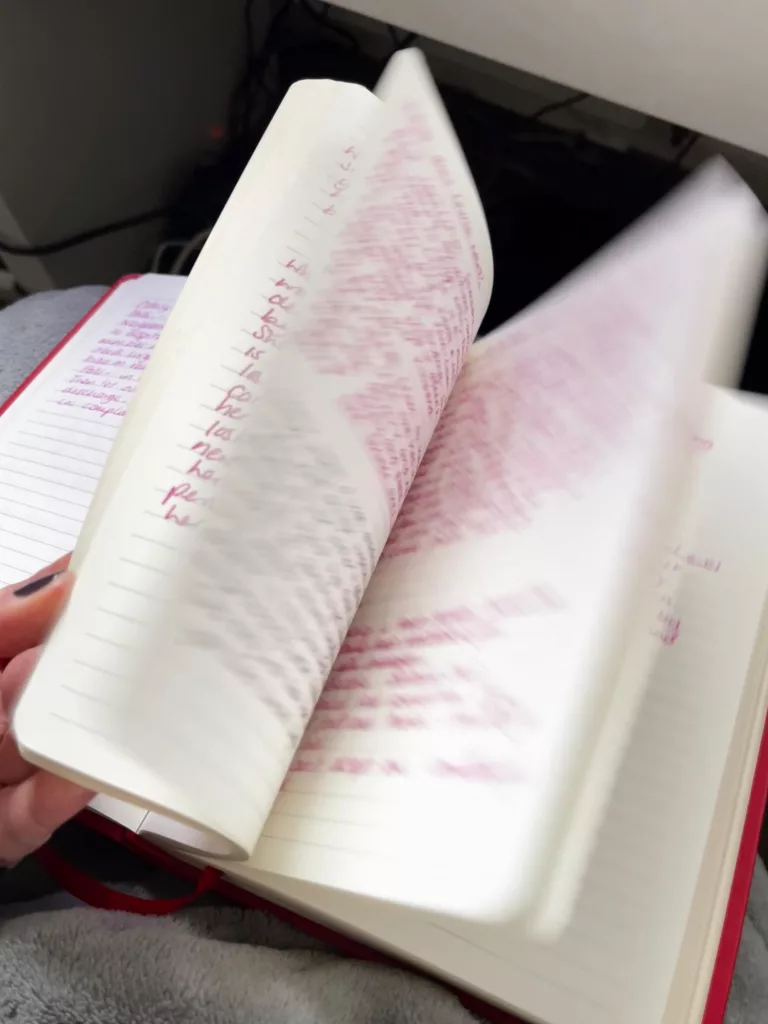
Your pages don’t need to be good. They don’t need to be coherent. I write Morning Pages every morning and sometimes, I can’t even read my own handwriting! That’s the whole point.

What Changes When You Let Go of the Hustle
Here’s what I’ve noticed since I shifted to this gentler approach, and this is what a meaningful daily writing practice actually creates:
You show up more consistently, because there’s no pressure. You’re not white-knuckling your way through 2,000 words a day. You’re simply arriving at your desk or your notebook with curiosity instead of dread.
Your writing improves, because you’re not exhausted. Your creative brain isn’t running on fumes. It has space to think, to imagine, to take risks.
You rediscover the why. Remember when you first fell in love with writing? When it was just the thrill of telling a story? That comes back. Slowly, gently, but it comes back.
And your relationship with rejection, or with the business side of writing, gets lighter. Because your worth as a writer isn’t tied to external validation anymore. You’re writing because you’re a writer. Not because someone else said so. Not because you sold a book. But because you show up, day after day, and do the work.

The Rest Days Matter Too
One more thing I want to say, because this is where so many of us get it wrong, and I may need to shout this, RESTING IS IMPORTANT TOO!
Taking time to create an aesthetic writing space that feels like a sanctuary isn’t distraction—it’s honoring the work. Setting a writing routine that includes rest, or boundaries around your time, or permission to step away when you’re burned out—these aren’t failures. They’re wisdom.
If you’ve been in the grind, if you’ve experienced rejection and the emotional toll of the publishing industry, if you’ve written until you hated writing, please know that a sustainable practice looks different. It’s slower. It’s gentler. It’s less about performance and more about presence.
And it’s the only way you’re going to fall back in love with your craft.
Your Invitation
This is the kind of writing life we celebrate inside the Giddy Hygge Writing Society. A practice built on process, not outcomes. One where showing up matters more than publishing. Where your morning pages are just as valuable as your finished manuscript. Where rest is celebrated alongside creation.
We’re building a community of writers who are tired of the grind and hustle, who want to fall back in love with writing, and who believe that the ritual of writing is where the real magic lives.
Join the waitlist for The Giddy Hygge Writing Society. Limited spots available for writers who want to reclaim the joy of their creative practice.