A Darker History Walk Through Bowness-on-Windermere
I’ll be honest. I’d stopped seeing Bowness.
When you live on the cusp of somewhere this pretty, it slowly turns into the place you pass through on the way to somewhere else.
The shops become errands, the lake becomes background, and the old stone church in the middle of the village becomes something you walk around rather than into.
So on a bright, blustery October afternoon, I walked down from Windermere and tried to see Bowness-on-Windermere the way a visitor would. Except I write psychological thrillers, so I couldn’t help looking for what sits underneath. (Too many years of Twin Peaks, probably.) Pretty places are perfect for it. You can let your imagination run wild while knowing that you’re perfectly safe in a lovely Lake District village where nothing is going on at all.
Probably.
Here’s the Bowness-on-Windermere history I found: a gate built for coffins, two gravestones that tell opposite sides of the same story, the oldest pub in Bowness and the champion wrestler who ran it, and a quiet spot on the water that most people walk straight past. If you’re new to the area, my local’s guide to things to do in Windermere is a good place to start too.
The walk at a glance
- Start: Windermere village, or the centre of Bowness if you’re staying there
- Getting there: about 30-40 minutes on foot from Windermere to Bowness
- Time: a gentle couple of hours with stops, plus about an hour if you add the lakeside loop to Cockshott Point
- Dogs: fine on the walk and the lakeshore, but not inside the Hole in t’ Wall
- Best time: a weekday out of season, in daylight. It makes a very good Halloween walk.
Table of Contents
How do you get to Bowness without the parking nightmare?
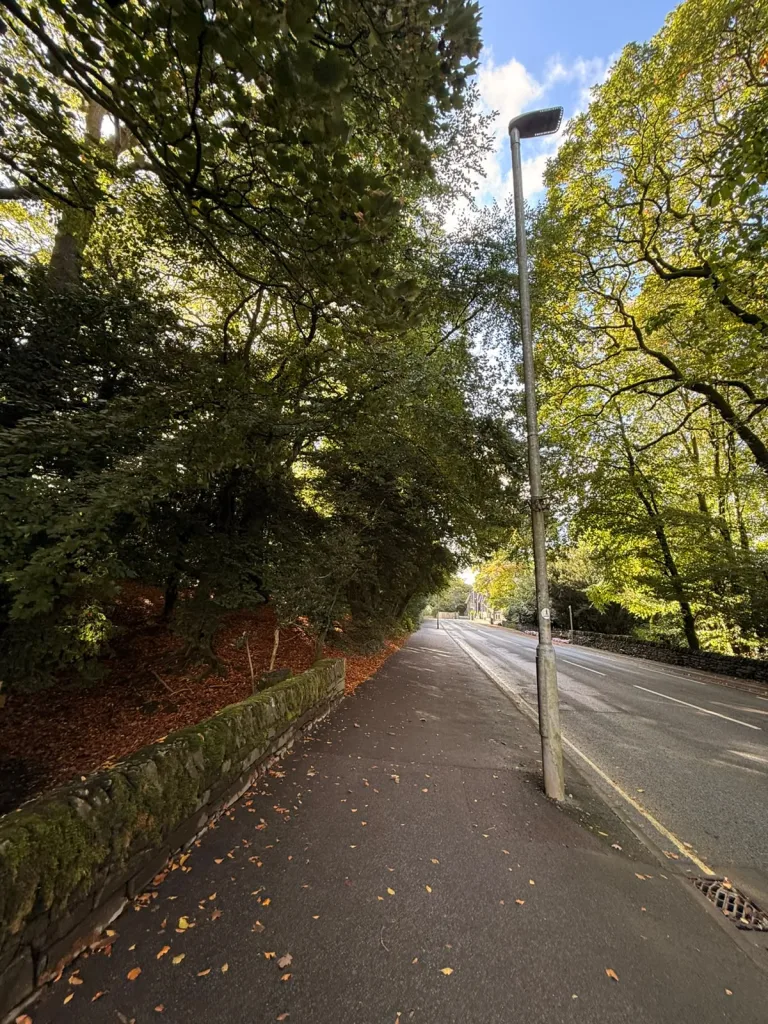
Walk, if you possibly can. Bowness has one narrow main street that gets busy and slow, and the car park in the centre and the one by the side of Hole in t’Wall get full quickly. You can park up in some of the side streets just outside of Bowness or walk from Windermere village, which is about a 30-40 minute walk, and you arrive already in the mood for a potter. If you’re coming by train, regular buses also run from Windermere station down to Bowness.
Out of season, on a weekday afternoon, it’s a different place altogether. Quiet, unhurried, and full of the quirky independent shops that get lost in the summer crowds.
What’s inside Antiques on High in Bowness?
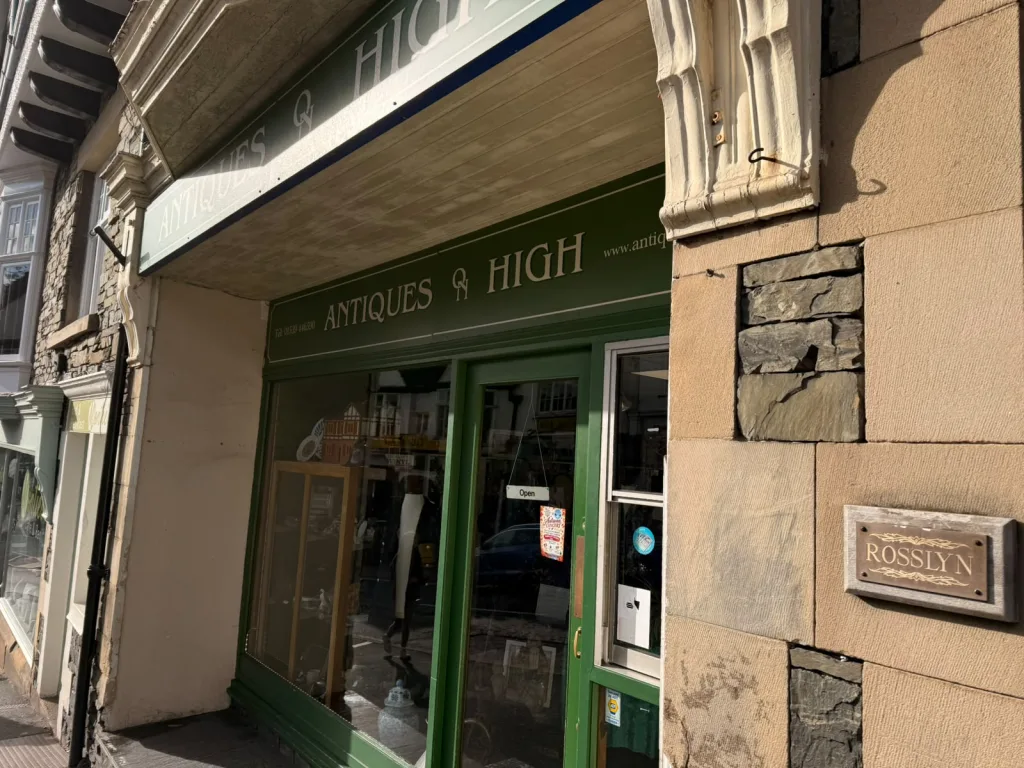
My first stop was my favourite antique shop, Antiques on High on Crag Brow, close to the World of Beatrix Potter. I’d always assumed it was a one-off. It turns out it’s part of what calls itself the country’s largest high street antiques retailer, with sister shops in Oxford, Harrogate, Sidmouth and Taunton. The Bowness branch opened in May 2021.
It works as a collective. Inside, it’s glass cabinet after glass cabinet, each stocked by a different dealer, with one person looking after the whole shop. Their own website describes it as ‘almost Tardis-like inside’, and that’s fair. It goes back much further than you expect from the street.
What I found on one afternoon:
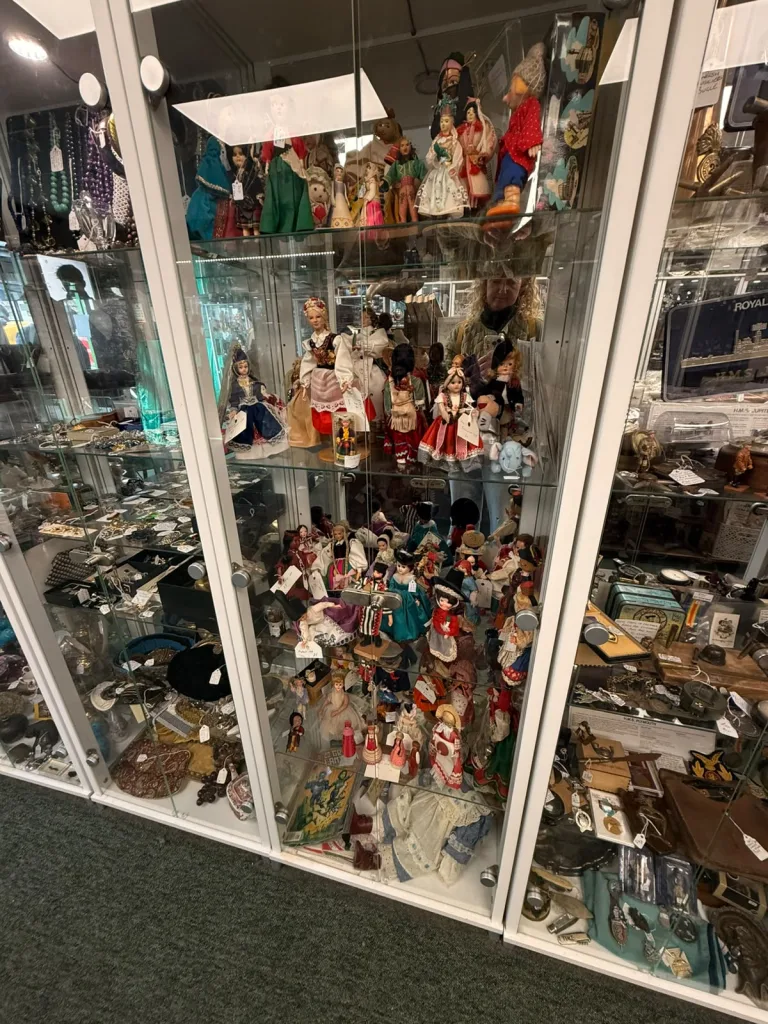
- A whole cabinet of costume dolls from around the world, in lace and velvet and embroidered aprons
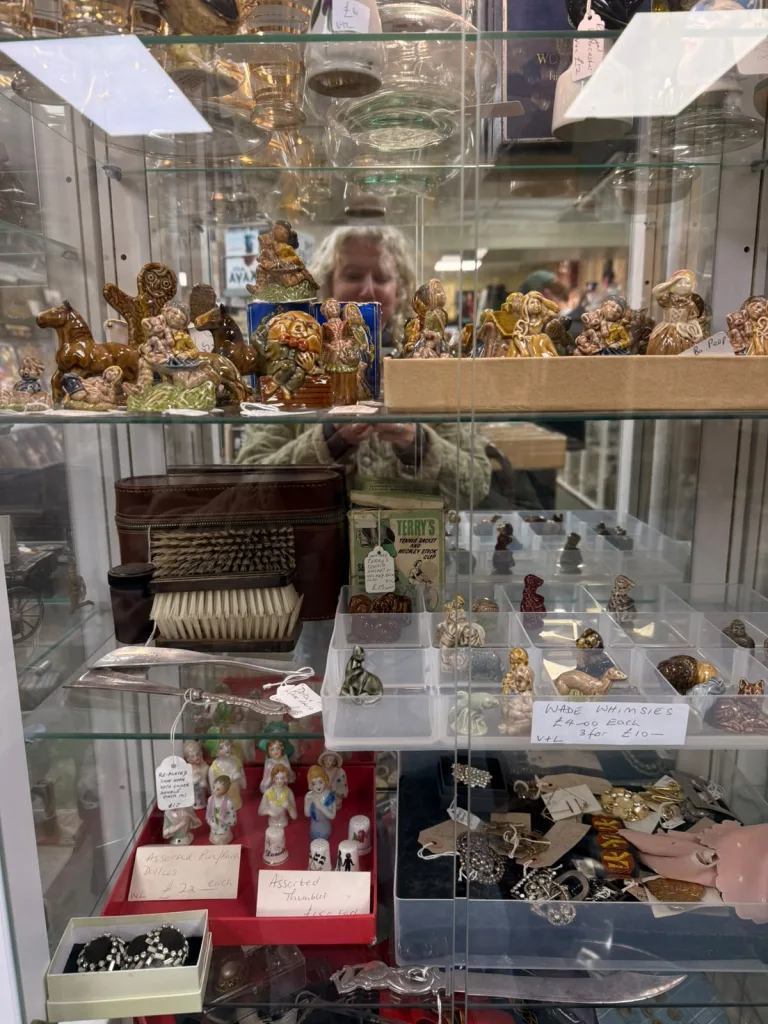
- Wade Whimsies at £4 each (or three for £10), pin cushion dollies and painted thimbles
- A re-plated shoehorn with a silver handle from around 1917, and a 1950s tennis racket clip still in its box
- Shelves filled with second-hand books, with old Lakeland walking guides wedged between paperback thrillers
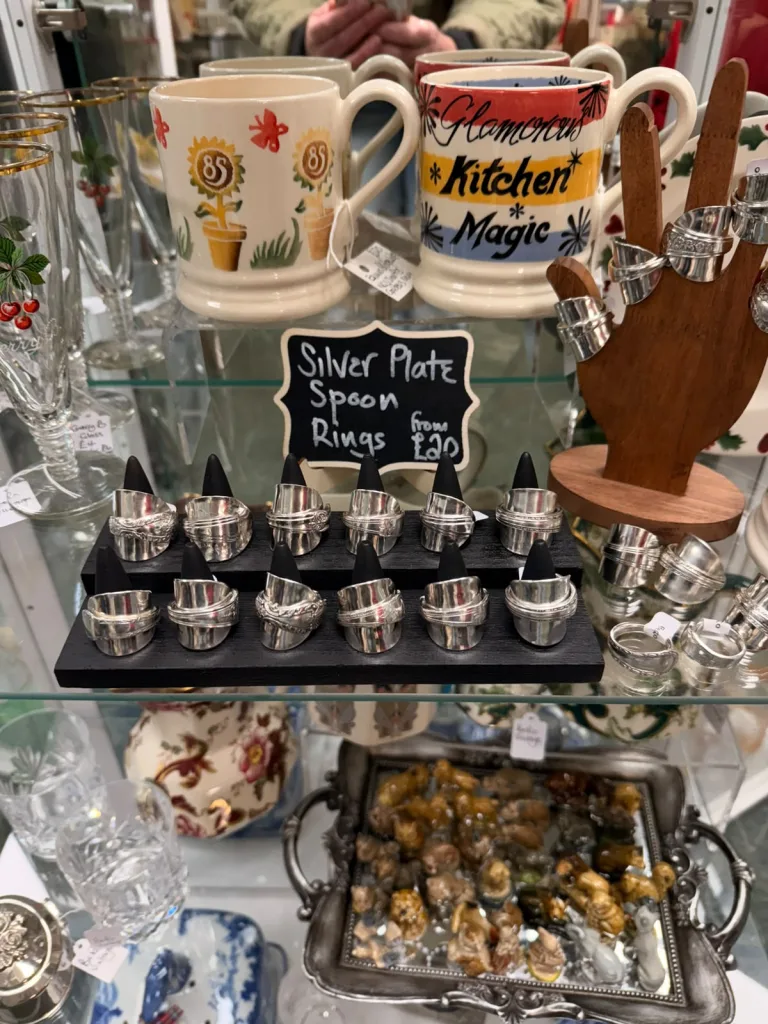
- A tray of silver-plate spoon rings, from £20 which I had to try on, obvs.
Why? Because I had a spoon ring years ago, until someone (who shall remain nameless) pinched it and then broke it. So I came away with a Christmas present sorted. Hurrah!
The writer in me can’t look at cabinets like these without wondering about the last owners. Who carried those dolls home from their travels? Whose handwriting is on the flyleaf of that walking guide? Every object in there belonged to somebody once, and now it’s waiting for somebody new.

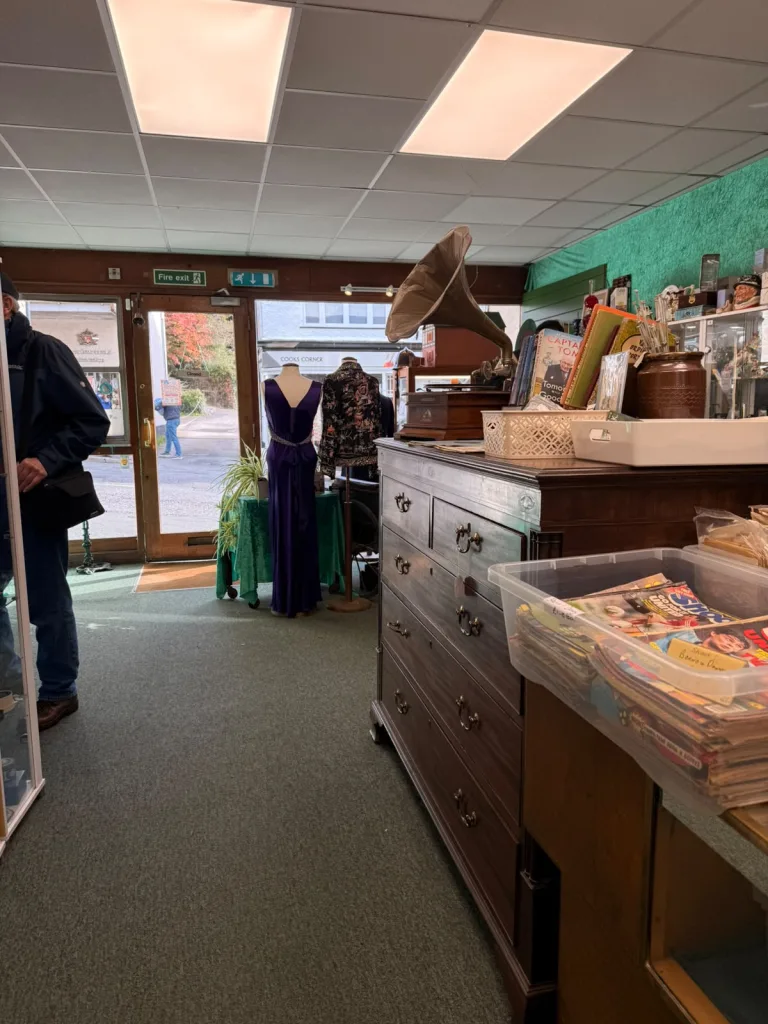
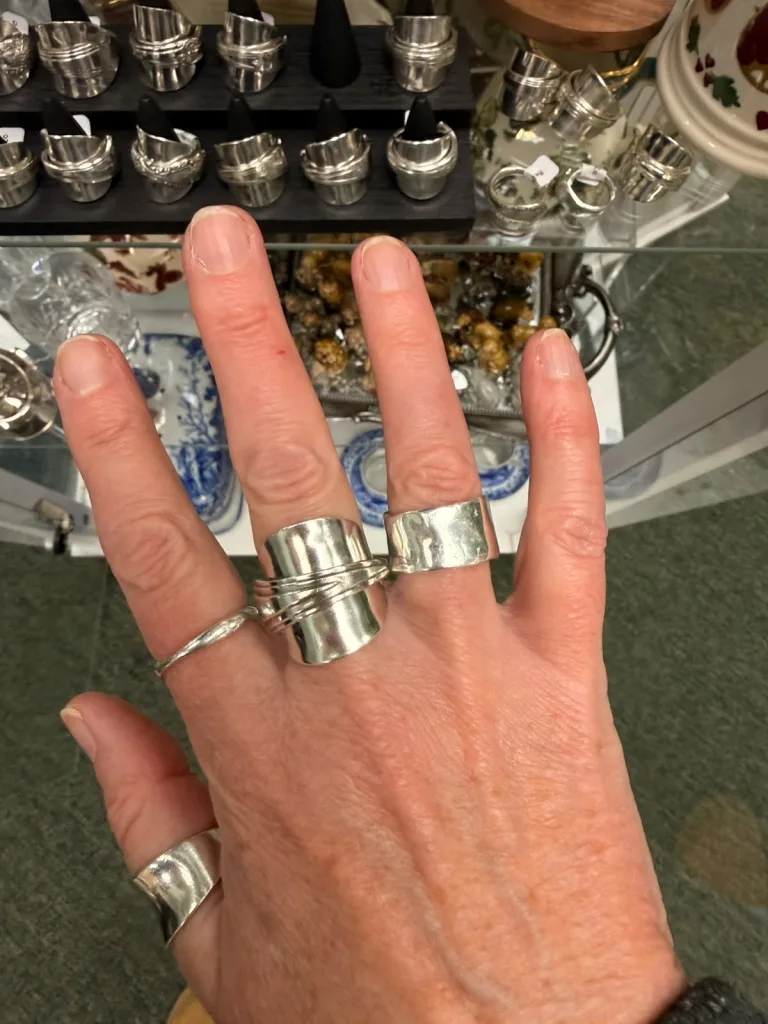
Good to know: Antiques on High is open Monday to Saturday, 10am to 5pm, and Sunday, 11am to 5pm. Hours can change with the seasons, so check their page before you go.
What is the lychgate at St Martin’s Church for?
A minute away, in the middle of the village, is St Martin’s Church. Which is super pretty and filled with character. You go into the churchyard through a wooden gate with its own little peaked roof. It’s a lychgate, and I’ve walked under this one a fair bit and been inside this lovely church a fair bit as well. It’s only today that I actually looked up the history of it all, and wowzer. What history.
I always thought the peaked roof and wooden gate, the ‘lych’ was something to do with weddings. It isn’t. ‘Lych’ comes from the Old English word for a corpse (more on lychgates here). The roof sheltered the coffin, and the people carrying it, while they waited for the clergyman to arrive (VoiceMap’s Bowness tour calls it the corpse gate).
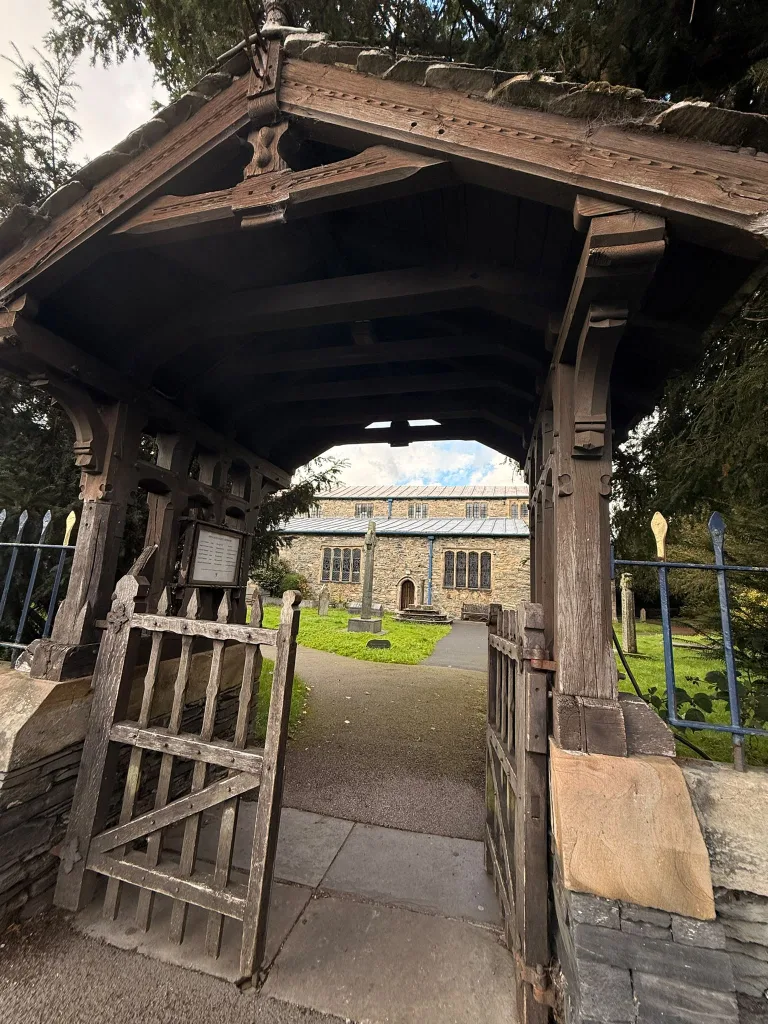
When you get there, stand under it and look at the church roof. It’s grey lead, not the slate you see on almost every other building round here. The old story is that when the church was being built, whoever gave the most money got to choose the site. A carrier who’d made his fortune offered to cover the whole church in lead, and nobody could match it (the story is retold here).
Good to know: St Martin’s is usually open on weekday mornings, 9.30am to 1pm, with longer opening from Palm Sunday to the end of September (National Churches Trust). Go in the morning if you want to see inside. The churchyard is easy to walk round at any time in daylight.
Who is buried at St Martin’s Church, Bowness?
This is the part of the walk that stayed with me. Right in the middle of all the hustle and bustle (the cafes, the pubs, the shoppers, the tourists), there’s this so much history, and people are walking straight past it. Me included when I’ve been to this church before. Here’s what I found out and what I didn’t know before writing this blog post.
The wedding party of 1635
On 19 October 1635, a wedding party was coming home across the lake from Hawkshead when a sudden storm sank the ferry. Forty-seven people drowned, along with eleven horses. It’s the largest loss of life ever recorded on Windermere, and the dead were buried together in a common grave that now lies under the church’s extended chancel (VoiceMap).
Locals remembered it as ‘The Mournful Marriage’, and the shipwreck turns up in a dramatic Romantic painting by De Loutherbourg, Belle Isle, Windermere, in a Storm, which hangs at Abbot Hall in Kendal. I visited a few days before the anniversary, and I’m fairly sure I walked right past the spot without realising.
Rasselas Belfield
You have to walk right round the back of the church to find this one. It’s tucked against a bank of holly, with fallen leaves around its base, and the lettering is worn and hard to read.
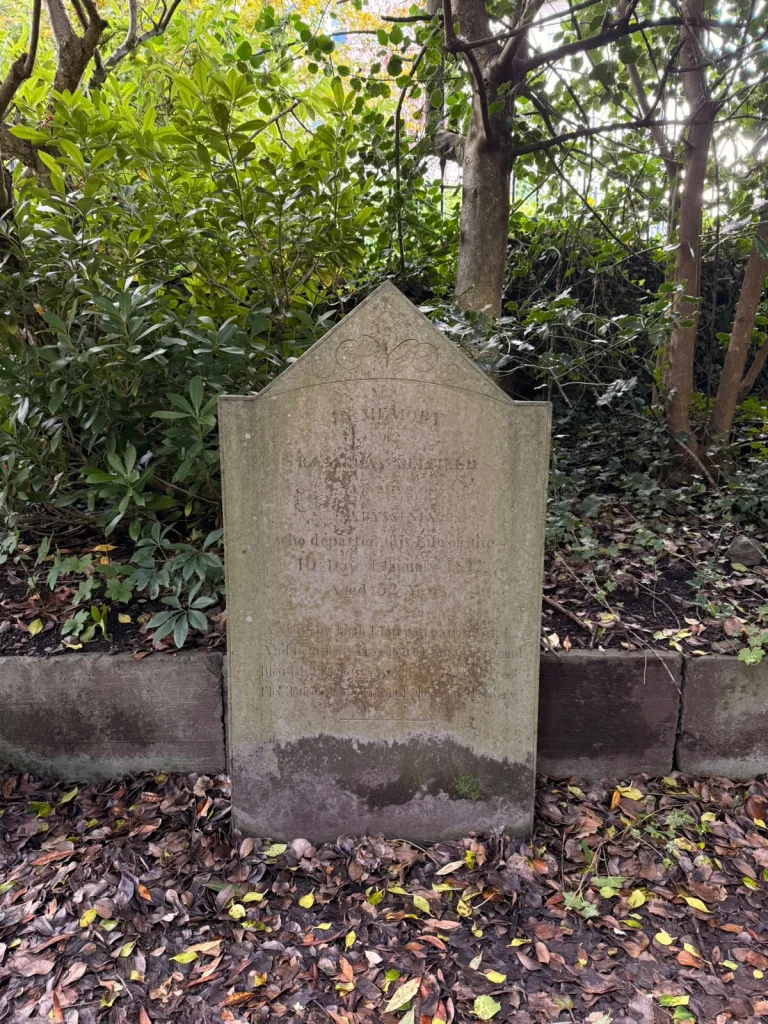
Rasselas Belfield came from Abyssinia (now Ethiopia). He was baptised here in April 1803 as ‘Captain Taylor’s servant of Bellefield’, when he was about 13. His surname wasn’t his own, it came from Belfield, the house on the lake shore that Isabella Taylor built in 1794. He died on 16 January 1822, aged 32. His epitaph, which is at the bottom, but really hard to see, reads:
A Slave by birth I left my native Land, And found my Freedom on Britania’s Strand Blest Isle Thou Glory of the Wise and Free! Thy Touch alone unbinds the Chains of Slavery!
Historic England says the quality of the stone shows how much the Taylor family valued him, but that we don’t know enough to say whether he was actually enslaved, or at what point in his life.
John Bolton of Storrs Hall
And then, at the west end of the church, is the tombstone to John Bolton. Bolton was a Liverpool merchant who invested in dozens of slaving voyages, owned plantations in the Caribbean, and lived at Storrs Hall on the shore of Windermere (UCL Legacies of British Slavery). When slavery was abolished, he was paid compensation for the people he’d enslaved.
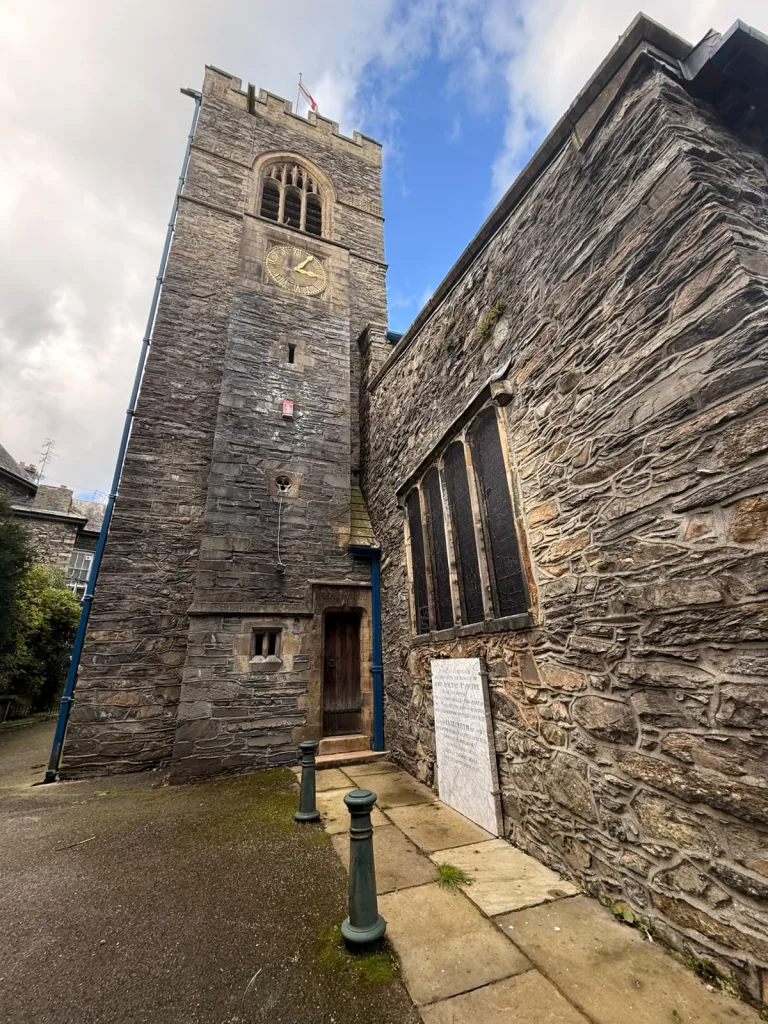
Two stones, a few yards apart. One praising Britain for unbinding the chains of slavery, and one for a man who made his fortune from them. Historic England listed Rasselas’s tomb in 2008, partly because of the way the two stones sit together in one churchyard. Stand at one and look across to the other.
I found it a strange, uncomfortable, important thing to do, and I’d never done it before, despite living so close.
Is the Hole in t’ Wall really the oldest pub in Bowness?
Just round the corner, down a curving lane lined with slate walls on Lowside, is the Hole in t’ Wall. Its proper name is the New Hall Inn, and the sign above the door says 1612, ‘Oldest Tavern in Bowness’ and ‘Frequented by Charles Dickens’.
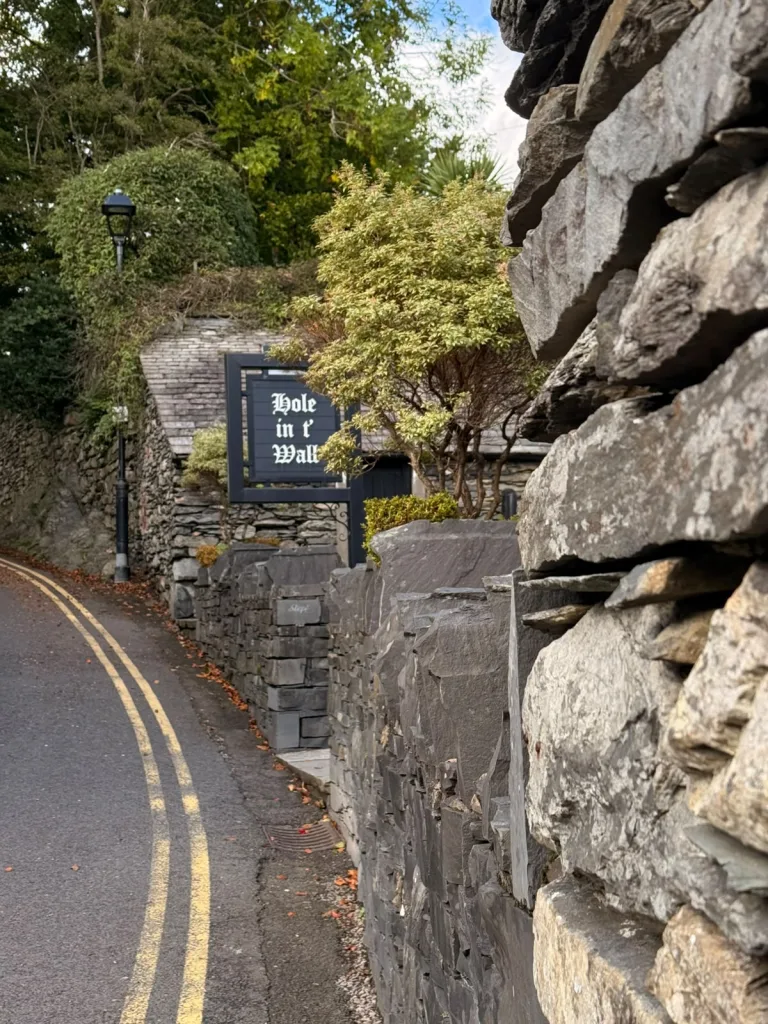
The nickname comes from the story that a hole was knocked through the wall to the blacksmith’s next door, so he could be served his ale while he worked. Another plaque remembers Thomas Longmire, ‘Champion Wrestler of England’ and holder of 174 wrestling belts, who was landlord from 1852 to 1862. It says Dickens described him as ‘a quiet looking giant’ when he visited after the ferry sports in 1857.
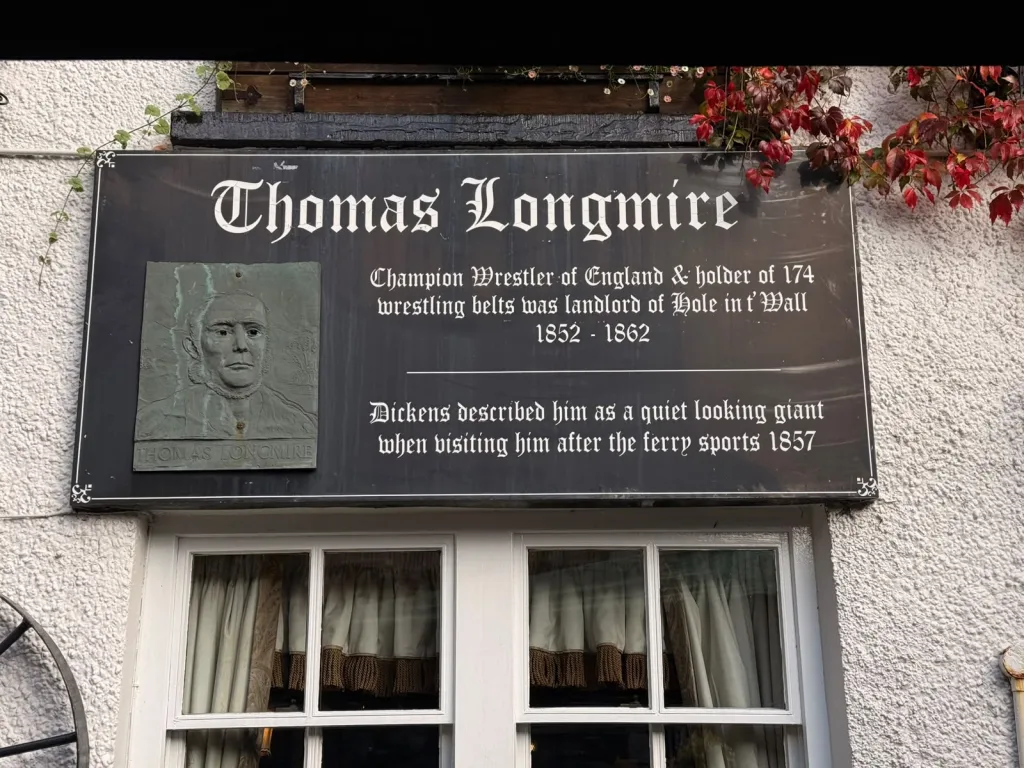
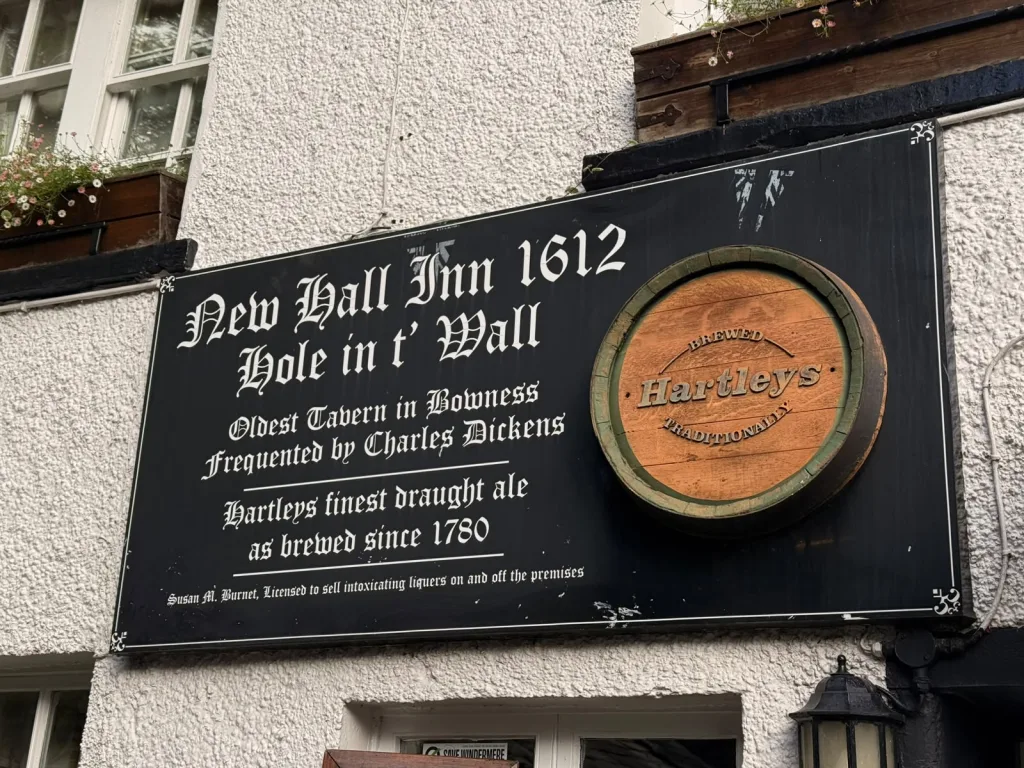
Is it true? One researcher who looked into it, even with help from the Dickens Fellowship, couldn’t find any record of the visit (Once Upon a Pint). I don’t mind either way. A story nobody can prove, painted on the front of a 400-year-old building, is my kinda story.
It’s full of character inside, with lots of nooks and crannies to tuck yourself into for a drink or a meal, and the food is good.
Good to know: no dogs inside. There’s live music sometimes at the weekends, but check before you go.
Where can you find a quiet spot on the lake in Bowness?
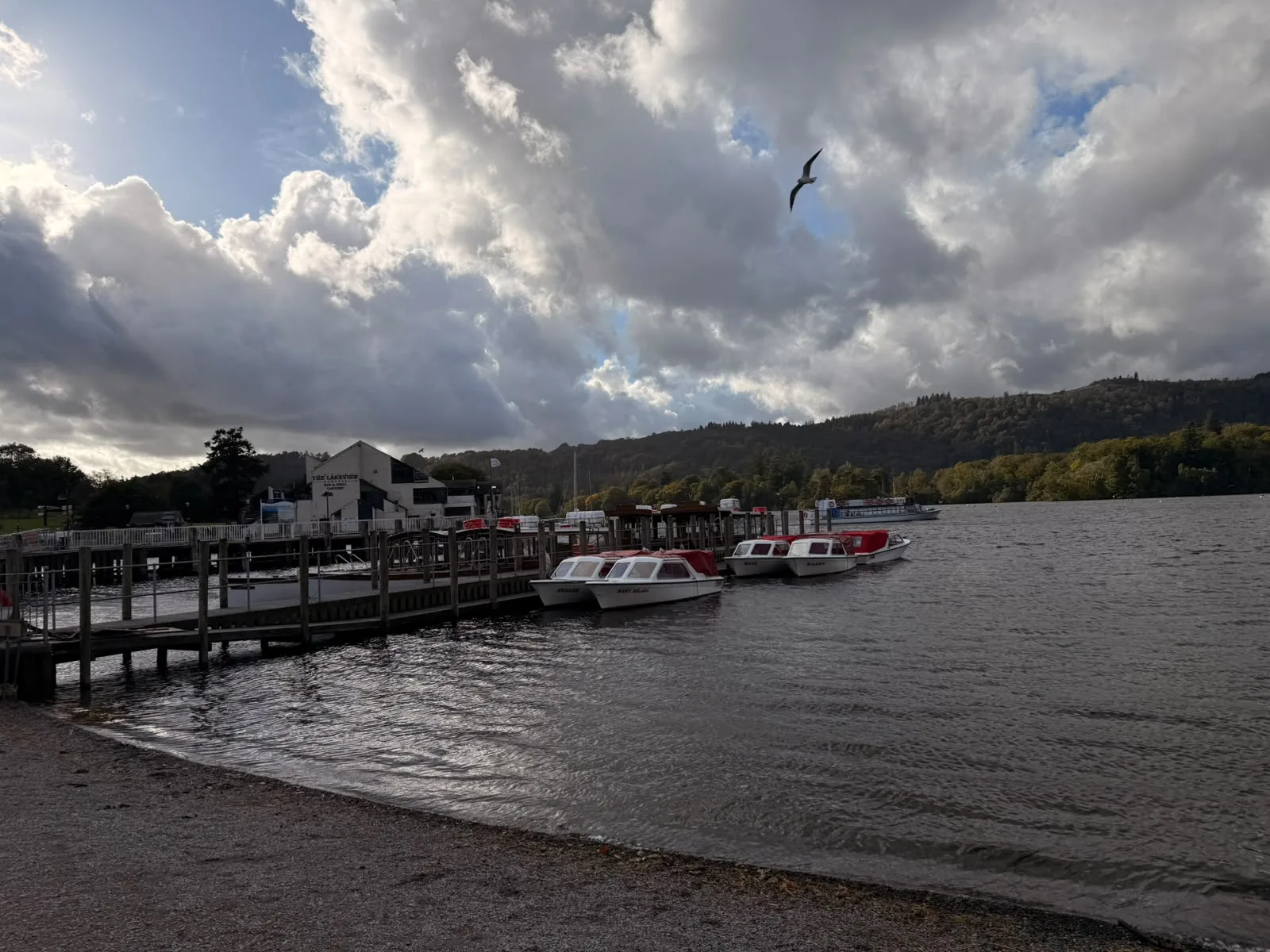
From the pub, I walked down to the water at Bowness Bay. This is where the Windermere Lake Cruises boats leave from, where everyone gathers, and where the birds know they’ll be fed. It’s lovely, but it’s busy, busy, busy.
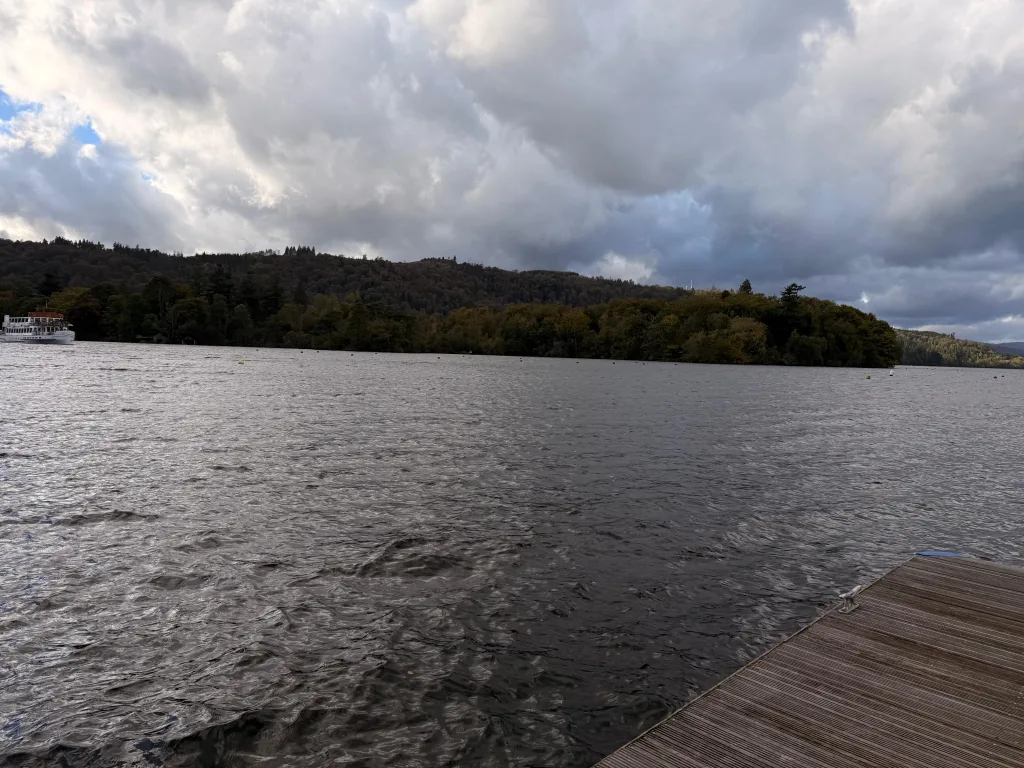
If you want to actually enjoy the lake, keep walking along the shore past the piers. It gets much quieter, with benches under the trees where you can sit right at the water’s edge. On my visit the wind was up, the water was choppy, the gulls were squawking, and the jetty was wobbling so much under my feet that I didn’t get very far along it.
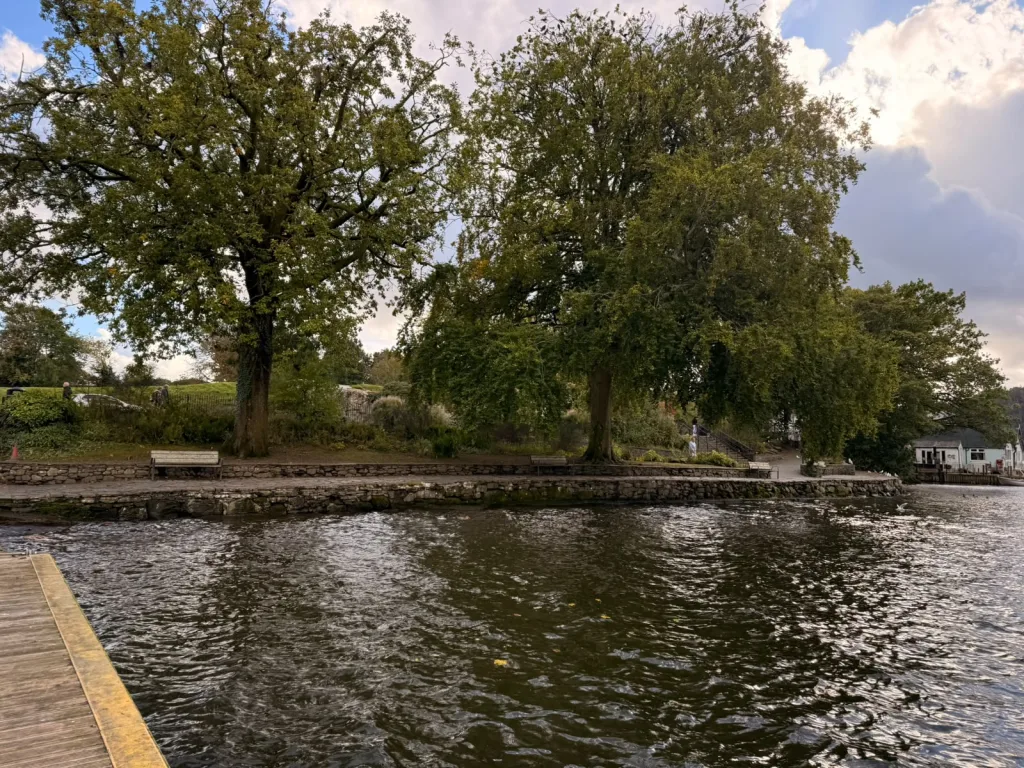
Looking across, there’s a long wooded island that I’m fairly sure is Belle Isle, the largest island on Windermere. It’s privately owned, but somewhere in those trees is a round house built in 1774. Wordsworth was famously unimpressed and said it looked like a tea canister in a shop window (Lake District National Park).
Keep going and you reach Cockshott Point. The National Park has an easy Bowness to Cockshott Point route, a circular walk of just under 2km that takes about an hour. Most of it is on smooth, surfaced paths and suitable for all, with a short grassy detour out to the point itself.
Cockshott has its own odd little piece of history. Windermere is where Waterbird, credited as the first successful British seaplane, took off in November 1911. The next year, the Lakes Flying Company leased land at Cockshott, and the noise caused an uproar. Canon Rawnsley led the protest, and Beatrix Potter wrote to Country Life that the propeller sounded like ‘millions of blue-bottles plus a steam threshing machine’ (Waterbird). Hard to imagine on a quiet autumn afternoon, with nothing louder than the gulls.
Is this a good walk for Halloween in the Lake District?
Yes, I think it’s perfect. It’s short, it’s in the middle of the village, and it has everything an October afternoon needs: a gate built for coffins, a mass grave from a drowned wedding party, two gravestones that make you think, a pub with a ghost of a Dickens story that serves good food and beer, and a dark, wind-whipped lake to finish.
Go in daylight, start in the morning if you want to see inside the church, and finish in the Hole in t’ Wall.
Practical tips
- Toilets: there are public toilets, cafes and pubs in Bowness. The toilets at Ferry Nab close in winter.
- Accessibility: the village is compact, and most of the lakeside path is smooth and surfaced. The grass out to Cockshott Point isn’t easy for wheelchairs, and there’s a fairly steep uphill stretch on the way back if you do the full loop.
- Dogs: welcome on the walk and the lakeshore, but not inside the Hole in t’ Wall.
- Timing: weekdays out of season are the quietest. In summer, go early.
Bowness-on-Windermere history
Is Bowness-on-Windermere worth visiting in autumn?
Yes. It’s one of the best times to go! Out of season it’s quiet and unhurried, the light is beautiful, and you can actually see the old village.
Is St Martin’s Church in Bowness open to visitors?
Usually on weekday mornings, 9.30am to 1pm, with longer opening from Palm Sunday to the end of September. The churchyard is open in daylight, but always check directly before you go.
Where is Rasselas Belfield’s grave?
In St Martin’s churchyard, near the east end of the church, tucked against the planting at the back. John Bolton’s is over by the west end.
Can you take dogs into the Hole in t’ Wall?
No, dogs aren’t allowed inside.
How far is Bowness from Windermere?
About a 30 – 40 -minute walk, or a short bus ride from Windermere station.
Seeing Bowness with new eyes
I live close enough to Bowness that it’s easy to become blind to it. Doing this walk through a visitor’s eyes, and a thriller writer’s, made me love it a little bit more.
It also made me laugh, because the main character in my novel In Her Pocket, Jane, can’t stand driving through Bowness. She sees it the way a local does in August with all the double-parking, the pedestrians who wander into the road without warning, and the dogs on very long extender leads that trip you up.
Same street, two sides of the same coin.
Beautiful places hide terrible things. Sometimes they’re just round the back of the church.
If you’d like more places like this, grab my free Windermere map below, and have a look at my local’s guide to things to do in Windermere.